
The recent campaign of the Pakistan national cricket team in the ICC Men’s T20 World Cup has left fans frustrated, disappointed, and questioning the direction in which the team is heading. Once considered one of the most unpredictable yet dangerous teams in world cricket, Pakistan now appears to be struggling with consistency, planning, and leadership. Their failure to qualify for the semifinals in the latest edition of the tournament has triggered a wave of criticism from supporters and former players alike, many of whom believe the team has lost its competitive edge.
For decades, Pakistan cricket has been associated with raw talent and match-winning brilliance. The country produced legendary cricketers such as Wasim Akram, Waqar Younis, and Imran Khan—players who defined eras and inspired generations. Even in the modern era, stars like Babar Azam and Shaheen Shah Afridi have showcased the immense potential present in Pakistan’s cricketing structure. However, talent alone is not enough to succeed in international cricket anymore. Modern cricket demands strategy, adaptability, mental strength, and consistent execution under pressure.
In this T20 World Cup campaign, Pakistan failed to display many of these qualities. Their performances lacked urgency, tactical awareness, and clarity in team selection. In crucial matches, the team appeared hesitant and unsure of its game plan. While other teams adopted aggressive and innovative approaches, Pakistan seemed stuck with outdated strategies that failed to deliver results.
One of the biggest criticisms directed at the team has been its batting approach. Pakistan’s top order has often been accused of playing too cautiously in a format that demands fearless stroke play. In several matches, the team struggled to accelerate during the middle overs, which placed unnecessary pressure on the lower order. In T20 cricket, where momentum can shift within a few overs, the inability to maintain a healthy run rate can prove disastrous—and that is exactly what happened during Pakistan’s campaign.
Another concern has been the lack of depth in the batting lineup. When the top order failed to deliver, the middle order struggled to stabilize the innings or accelerate when required. Modern T20 teams rely heavily on flexible batting orders, power hitters, and finishers who can change the course of the match within a few overs. Pakistan, however, appeared overly dependent on a few individuals rather than a collective unit capable of delivering match-winning performances.
Bowling, traditionally Pakistan’s strongest department, also failed to live up to expectations. While the pace attack still has world-class potential, the bowlers struggled with consistency and execution during key moments of the tournament. Death bowling in particular became a major concern, with opposition teams capitalizing on loose deliveries and building strong finishes.
Fielding, an area that has increasingly become decisive in modern cricket, was another weakness exposed during the tournament. Dropped catches, misfields, and poor ground coverage allowed opponents to gain crucial advantages. In a format where matches are often decided by the smallest margins, these lapses proved costly.
The disappointment among fans has been immense. Pakistani supporters are known for their passion and emotional investment in the sport. Social media platforms were flooded with reactions ranging from criticism to frustration. Some fans went as far as labeling the team’s performance “shameless,” reflecting the depth of disappointment felt after such a lackluster campaign.
Beyond the emotional reactions, there are also genuine concerns about the future of Pakistan cricket. The global landscape of the sport is evolving rapidly. Teams like Afghanistan and Ireland have shown remarkable improvement, while associate nations continue to develop competitive squads. If traditional cricketing powers fail to adapt, the gap between them and emerging teams will quickly narrow.
For Pakistan, the warning signs are already visible. Their inconsistent performances in major tournaments raise questions about planning, domestic development, and long-term vision. Without structural reforms and a clear roadmap, the team risks falling behind other nations that are investing heavily in modern coaching systems, analytics, and player development.
There is also a growing debate about leadership and team management. Successful international teams rely on strong communication between players, coaches, and administrators. When that alignment is missing, confusion often reflects on the field. Pakistan cricket has frequently faced issues related to frequent captaincy changes, selection controversies, and administrative instability. Such factors inevitably affect player confidence and team performance.
Despite the criticism, it would be unfair to dismiss Pakistan cricket entirely. The country continues to produce extraordinary talent, particularly fast bowlers who can challenge the best batting lineups in the world. The challenge lies in nurturing that talent with proper guidance, discipline, and modern training methods.
History has shown that Pakistan cricket is capable of dramatic comebacks. The team has often risen from difficult phases to deliver remarkable performances on the global stage. However, a revival will require honest introspection and decisive action from administrators, coaches, and players.
The disappointment of this T20 World Cup should serve as a wake-up call. If the same patterns of inconsistency and mismanagement continue, Pakistan could face the embarrassing prospect of struggling in qualification pathways for future global tournaments. But if lessons are learned and reforms are implemented, this setback could become the starting point for rebuilding a stronger and more competitive team.
For a nation where cricket is more than just a sport, the hope remains that Pakistan will rediscover the fearless and unpredictable spirit that once made them one of the most exciting teams in world cricket.
Final Perspective:
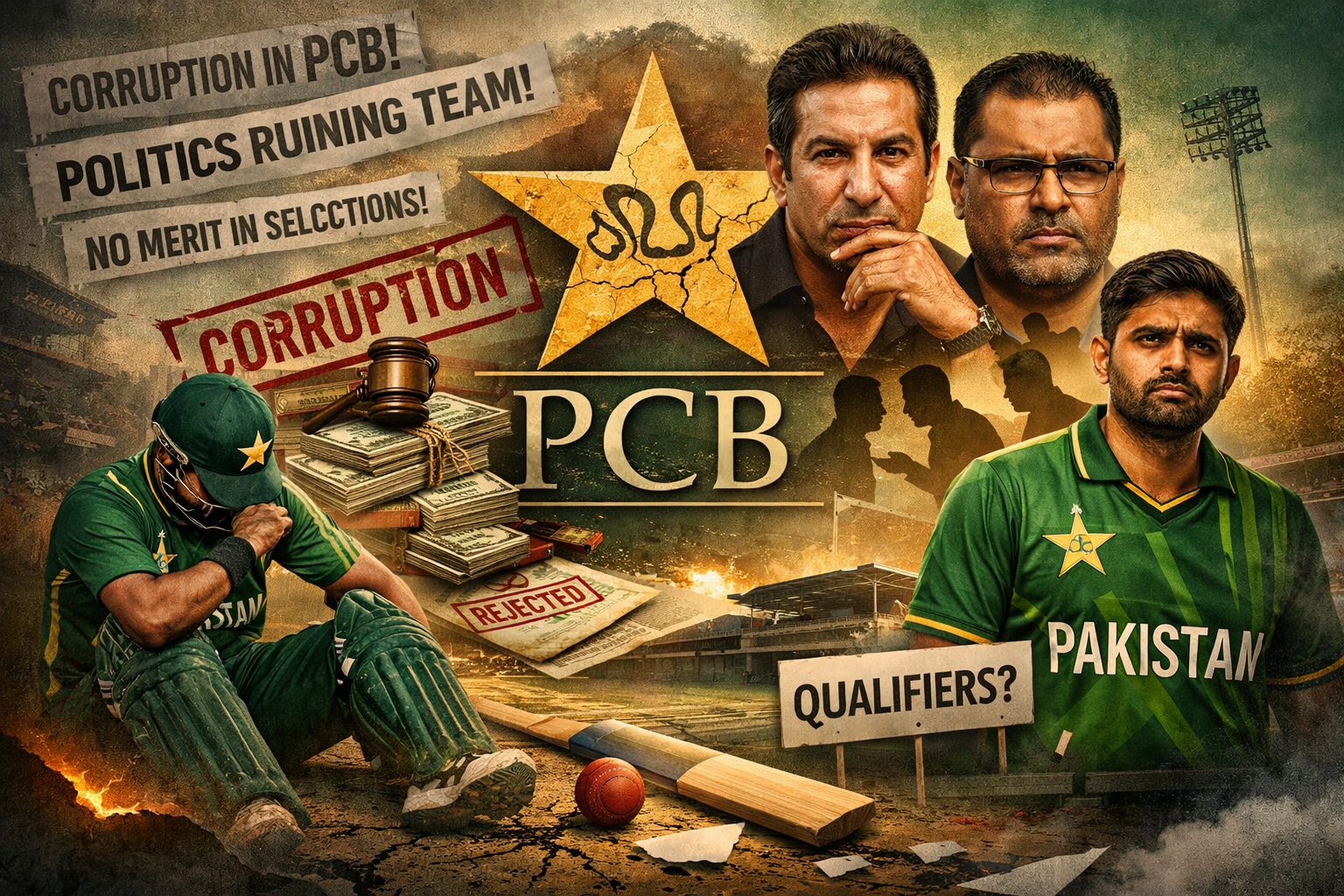
Beyond poor performances on the field, many critics believe deeper structural problems have played a major role in the decline of the Pakistan national cricket team. Issues such as corruption allegations, non-merit based selections, and internal politics have frequently been discussed by former players, journalists, and fans. These factors have created an environment where stability and professionalism are often compromised.
One of the biggest complaints revolves around the lack of transparency in the selection process. In a cricket-loving nation with immense grassroots talent, opportunities should ideally be distributed purely on performance and merit. However, critics often argue that deserving players are overlooked while others receive repeated chances despite inconsistent performances. When selections appear influenced by favoritism or personal connections, it inevitably damages the morale of domestic players who work tirelessly hoping to represent their country.
Domestic cricket should be the backbone of any successful national team. Countries with strong domestic systems consistently produce well-prepared players capable of handling international pressure. Unfortunately, Pakistan’s domestic structure has gone through frequent changes over the years, often driven by administrative decisions rather than long-term planning. These constant shifts have created confusion among players and coaches, making it difficult to build a stable development pathway.
Internal politics within cricket administration has also been a recurring issue. Leadership changes, disputes between officials, and conflicts between management and players have often dominated headlines. Such instability trickles down to the dressing room, where players are left uncertain about their roles and future. Successful teams usually thrive in environments where leadership is clear and decisions are consistent. Unfortunately, Pakistan cricket has often struggled to maintain that stability.
Former legends of the game have occasionally voiced their concerns about these problems. Greats such as Wasim Akram and Waqar Younis have, at different times, emphasized the need for professionalism, meritocracy, and long-term planning. Their concerns highlight the frustration many experienced cricketers feel when they see systemic issues preventing talented players from flourishing.
The pressure on modern players like Babar Azam has also increased because of these circumstances. When the administrative structure is unstable, the burden often falls heavily on the captain and senior players to deliver results despite the chaos around them. While leadership on the field is crucial, even the most talented players cannot compensate for structural weaknesses within the system.
Fans, who are among the most passionate supporters of cricket in the world, feel particularly disappointed because they know the country has immense talent waiting to be discovered. Every year, local tournaments across Pakistan produce promising young players with extraordinary skills. But unless those players are nurtured through a transparent and professional system, their potential may never translate into international success.
For Pakistan cricket to regain its lost glory, reforms must begin at the administrative level. Transparent selection policies, stronger domestic tournaments, and reduced political interference could help rebuild trust among players and fans. A system that rewards performance rather than influence would not only motivate young cricketers but also strengthen the national team in the long run.
The setbacks in recent tournaments, including the ICC Men’s T20 World Cup, should act as a wake-up call for Pakistan’s cricketing authorities. If meaningful reforms are implemented, the team still has the talent to compete with the best in the world. But if corruption allegations, internal politics, and non-merit based selections continue to dominate the system, the struggles of Pakistan cricket may persist for years to come.
| Issue | Explanation | Impact on Pakistan Cricket |
|---|---|---|
| Corruption Allegations | Over the years, allegations of corruption and lack of transparency have been raised against administrators and officials involved in managing the Pakistan national cricket team. These accusations have created doubts about whether decisions are made in the best interest of cricket. | Damages credibility of the system, creates mistrust among fans, and affects the morale of players. |
| Non-Merit Based Selection | Many critics claim that selections are sometimes influenced by favoritism or personal connections instead of pure performance. Deserving players in domestic cricket often feel overlooked. | Talented players lose motivation, while the national team may miss out on players who could perform better at the international level. |
| Weak Domestic Structure | Frequent restructuring of Pakistan’s domestic cricket system has created instability. Players often struggle to adapt to changing formats, teams, and tournament structures. | Lack of a consistent development pathway prevents young talent from smoothly transitioning to international cricket. |
| Internal Politics | Conflicts between administrators, selectors, coaches, and players have often dominated headlines. Changes in leadership and disagreements within the management affect team stability. | Creates uncertainty in the dressing room and prevents long-term planning for team development. |
| Administrative Instability | Pakistan cricket has experienced frequent leadership changes in coaching staff, selectors, and captains. | Players struggle to adapt to constantly changing strategies and leadership styles. |
| Pressure on Key Players | Players such as Babar Azam often carry the burden of expectations when the system around them is unstable. | Overdependence on a few individuals weakens overall team balance. |
| Concerns Raised by Former Legends | Former greats like Wasim Akram and Waqar Younis have repeatedly emphasized the importance of professionalism and meritocracy in Pakistan cricket. | Highlights the need for structural reforms and long-term vision. |
| Fan Frustration | Pakistan has one of the most passionate cricket fan bases, and poor performances in tournaments like the ICC Men’s T20 World Cup have intensified criticism. | Growing dissatisfaction among supporters puts pressure on administrators and players alike. |
| Need for Reforms | Experts believe Pakistan cricket must adopt transparent selection policies, strengthen domestic competitions, and reduce political interference. | Reforms could help restore trust and rebuild a competitive international team. |
The post “Absolute Shamless” Pakistani Fans Tore Apart Their National Team on Social Media after Hamulating loss against Bangladesh appeared first on Sportzcraazy.
from Cricket News & Updates | Today Cricket Rankings | Latest Match Schedule https://ift.tt/XdtUAJm
via IFTTT




0 Comments