
Cricket Ball is one of the most important component belonging to Gentlemen’s game.
A Cricket expert are not the only ones who understand the art of reverse swing, seam bowling, yorkers, beamers and many more.
They also understand deep technicality lies behind- leather ball stiches, type and most importantly specification.
We will discuss each and everything in detail also we will dive deep into different type of balls with color variations used in different formats- Red ball, White Ball and Most Importantly Pink Ball.
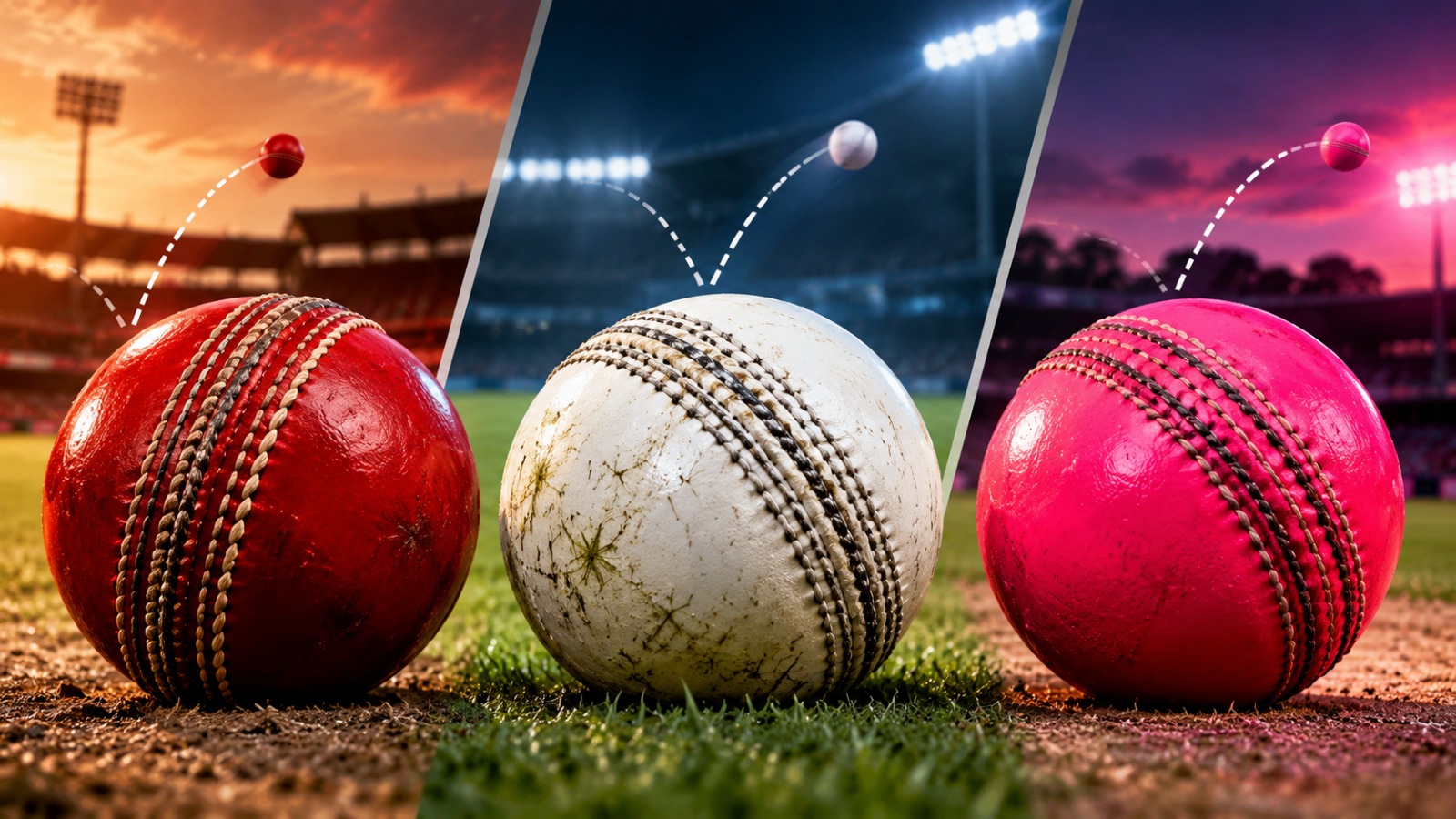
Before we describe different color balls specification, for naysayers Red ball is used for Test match( Longest Version of the Game), White Ball (Used for ODI Cricket) and Pink Ball ( Least Frequently used in Test Cricket as most players are not aware to adjust with pace of the game tactically)
Let me reveal different color variation balls and other details to be shared in the below format:
1. Red Ball:
The Red Ball is used for Test Cricket as well as in First Class matches, the reason behind using these balls as they work well against green daylight which works really well as the players wears contrastingly white, also red balls are widely known for sustainability approach, where the same ball can be used for longer duration.
There is no specific reason why color of ball turns out to be Red, as it has been started as tradition it has been widely accepted now so it still goes by the same name.
Red ball is usually treated with wax before lacquering it, one the final product is out it feels more like leathery rather than smooth ones, glossier touch is certainly more in comparison to white ball.
Based on detailed breakdown from BBC report, states that red ball has one fewer lacquer layer in retrospect to pink and white balls, due to which it wears down easily.
If you closely observe Red ball one side is completely scuffed and other one being smoother all these added terminology helps any bowler to exploit the contrast between two sides.
The contrasting part is not magic switch for swing but it plays an important role to attain that standard.
The red ball offers, appeal for suitable contest, in other words it also plays a vital role in changing the crux of any contest.
A new Red ball offers traditional swing and seam which certainly convert opportunities for bowlers, based on MCC ( Marlybone Cricket Club rule) after 80 overs which is practically equivalent to One Day, they can ask for new ball.
However the question arises, whether every 80 overs new red ball is granted which is not true that may stay true or false based on game context.
The ball is not suitable for night cricket where batters find it difficult to witness bowlers radar, It can be difficult to track.
Another significant reason why red ball signify- Its traditional aesthetic sense and most importantly that viability which runs for longer durations.
Red ball and test cricket have ideally go hand to hand, where these two symbolic indication speaks a lot about how longest format of the game would pursue.
2. White Ball:
The white cricket ball has become an essential part of modern limited-overs cricket, influencing how players approach batting, bowling and fielding throughout an innings. . Over time, the white ball became the standard choice for One-Day Internationals and T20 matches, creating a distinct playing environment compared with traditional red-ball cricket.
Visibility is one of the most important reasons behind its popularity. During matches played under floodlights, batters must identify the ball quickly against a dark background while judging its speed, direction and movement. The white surface provides a useful contrast, helping players follow deliveries from the bowler’s hand until the ball reaches the batter. Fielders also benefit from improved visibility when attempting to catch high balls, stop boundaries or throw accurately towards the wickets.
However, visibility is not determined by colour alone. Lighting conditions, the background of the ground, the condition of the ball and the speed of the delivery can all affect how easily players track it. As the innings progresses, the white surface may develop scratches, stains and marks from contact with the pitch and outfield.
The white ball also plays an important role in the strategies adopted by fast bowlers. Swing bowling allows a bowler to move the ball through the air, making it difficult for the batter to predict its final direction. Bowlers may use this movement to target the outside edge, attack the stumps or force batters into playing shots away from their bodies. The condition of the seam, the smoothness of the surface, the bowler’s wrist position and the release of the ball can all influence the amount of movement generated.
Different manufacturers use different construction methods, and the behaviour of a ball can change according to the weather, pitch, humidity and bowling technique. A delivery that moves significantly in one match may produce very little movement in another. Therefore, bowlers must assess the conditions and adjust their approach rather than depend entirely on the colour or finish of the ball.
Another important feature of men’s ODI cricket is the use of two new balls during an innings, with one ball used from each end and the balls alternating between overs under the applicable ICC playing conditions. This arrangement affects how the balls wear down during a match. Each ball is generally used for fewer overs than a single ball would be if it remained in use throughout the entire innings.
A comparatively new ball may retain its hardness and seam characteristics for longer, giving fast bowlers opportunities to generate movement. At the same time, batters may find that the ball continues to offer consistent bounce and pace, making certain attacking shots easier to execute. The precise impact depends on the playing conditions, the surface and the skills of the players involved.
Captains must also consider the condition of the ball when making decisions about field placements and bowling changes. During the opening overs, they may position more fielders in catching areas to exploit potential movement and create opportunities for early wickets. As the innings develops, the emphasis may shift towards restricting boundaries, protecting gaps and preventing batters from scoring freely. Bowlers can respond by using slower deliveries, yorkers, cutters and changes in length to disrupt the batter’s rhythm.
Maintaining the ball is equally important. Umpires monitor the ball throughout the innings and follow the relevant playing conditions if it becomes damaged or unsuitable for continued use.
Ultimately, the white cricket ball represents an important development in the evolution of limited-overs cricket. Its visibility supports matches played during the day and at night, while its surface, seam and condition influence the tactical decisions made by batters, bowlers and captains. Understanding these characteristics provides a clearer picture of why ball management and adaptability are essential skills in modern ODI and T20 cricket.
3. Pink Ball:
The first day-night Test match using a pink ball was played between Australia and New Zealand at Adelaide Oval on 27 November 2015.
The pink ball has a distinctive appearance and manufacturing process. Its bright colour helps players identify it against different backgrounds, while its outer finish is designed to protect the surface and maintain visibility for an extended period. The seam is generally dark, often black, creating a noticeable contrast against the pink leather. However, the exact construction, materials and finishing techniques can vary depending on the manufacturer.
Unlike a traditional red ball, which players regularly polish to maintain its shine and encourage swing, the pink ball has a protective coating intended to preserve its colour and surface. Nevertheless, it is not immune to wear and tear. As the match progresses, the ball collects dirt, develops marks and gradually changes in appearance. These changes can influence how easily batters, bowlers and fielders track it during different stages of the game.
One of the most interesting aspects of pink-ball cricket is the challenge presented by changing light conditions. During the afternoon, players compete in natural daylight. As the sun sets, the environment gradually changes before floodlights become the primary source of illumination. This transition, commonly called twilight, can create difficulties for batters attempting to judge the ball’s speed, line, length and movement.
The pink ball must remain visible against the pitch, outfield and background throughout these changing conditions. However, visibility is not determined by colour alone. The brightness of the surroundings, the age of the ball, the quality of the lighting and an individual’s eyesight can all influence how clearly the ball can be seen. Some players may find the ball particularly difficult to track around sunset, when natural light fades but artificial lighting has not yet completely transformed the playing environment.
For bowlers, these conditions can create opportunities to exploit uncertainty and test a batter’s technique. Batters, meanwhile, must adjust their concentration, footwork and shot selection according to the changing environment. Captains and coaches also need to consider how conditions may influence batting partnerships, bowling changes and field placements.
Ultimately, the pink ball represents an important innovation in modern Test cricket. It has helped organisers experiment with day-night matches while retaining the traditions and competitive demands of the longest format. Although questions about visibility, ball wear and playing conditions remain, pink-ball cricket offers a distinctive challenge that requires players to adapt their skills throughout the day.
Pink Ball Test Match usually played in Australia, where fans enjoy the fruits of this important junctures of the game.
| Feature | Red Ball | White Ball | Pink Ball |
|---|---|---|---|
| Format used | Test and First-Class cricket | ODI and T20 cricket | Day-Night Test cricket |
| Primary purpose | Suitable for traditional long-format cricket | Better visibility in limited-overs cricket, including under floodlights | Enables Test matches to be played across daylight and floodlit sessions |
| Visibility | Best suited to daylight conditions | Highly visible against darker backgrounds and under lights | Designed to remain visible through changing light conditions |
| Surface and coating | Wax-treated before lacquering; traditionally has one fewer lacquer layer | Surface and coating help maintain visibility and performance | Protective coating helps preserve colour and surface |
| Seam and swing | Seam and contrasting surface conditions help bowlers generate movement | Seam, surface condition and ball maintenance influence swing | Seam and surface characteristics influence bowling movement |
| Ball maintenance | Polishing helps maintain shine and encourage swing | Condition and visibility are monitored throughout the innings | Coating helps preserve appearance, but the ball still wears over time |
| Ball usage | A new ball may be requested after 80 overs under applicable playing conditions | Men’s ODIs use two new balls, one from each end | Used throughout day-night Test matches under applicable playing conditions |
| Major challenge | Difficult to track under floodlights | Can become stained, scratched and discoloured | Visibility can become challenging during twilight |
| Key tactical impact | Supports swing, seam movement and long-format bowling strategies | Influences batting, bowling changes, field placements and scoring strategies | Requires players to adapt to changing light and playing conditions |
| Historical milestone | Traditionally associated with Test cricket | Became standard in modern limited-overs cricket | The first day-night Test using a pink ball was played on 27 November 2015 at Adelaide Oval between Australia and New Zealand |
Frequently Asked Questions on Different Type of Balls:
Q-1: Tell us different color balls used in Cricket?
Answer: There are three different color balls used in cricket which include- Red Ball, White Ball and Pink Ball
Red Ball- Used for Test Cricket
White Ball- Used for ODI Cricket
Pink Ball- Used for Test Cricket especially in Australia.
Q-2: Tell us a technical difference between Red Ball, White Ball and Pink Ball?
Answer: There are several technical difference between Red ball, White ball and Pink Ball cricket to be shared in the below format:
A- Red Ball Cricket- More Lateral Swings and Seam early but tear down later.
B- White Ball Cricket- does generate swing and seam however it is also based on conditional thing.
Q-3: Decode Major Challenge encountered among all three different Type of Balls in Cricket?
Answer: Old Ball especially in relevance to Test Cricket generally wears down easily ideally it becomes difficult to upsurge swing and seam in the balls used for longer version.
Pink Ball still have to regain trust and that would only come if players and cricket expert adopt it otherwise playing with these balls would be one sided affair.
Two White Ball used in the same crux of the game, is seriously raises questions about ball maintenance that needs to be directed properly otherwise quality of these balls would subsequently tear down.
Q-4 Does the colour of a cricket ball affect swing and bowling performance?
Answer: The colour itself is not the only factor determining how a cricket ball swings. Its construction, seam condition, surface texture, lacquer, age and maintenance all influence its movement through the air. Red balls are traditionally associated with conventional swing and seam bowling in long-format cricket, where bowlers have more time to exploit changes in the ball’s condition. White balls can also swing, particularly when they are new, but their surface condition and the use of two new balls in men’s ODIs affect how they age during an innings. Pink balls are designed for day-night Test cricket and can offer movement under different lighting conditions. However, their behaviour depends on the specific ball, weather, pitch and atmospheric conditions. Bowlers must adjust their grip, seam position, length and line according to how the ball behaves during a match.
Q-5. Why is the pink ball important for day-night Test matches?
Answer: The pink ball has made it possible to schedule Test cricket across daylight, twilight and floodlit sessions, allowing spectators to watch more cricket outside traditional working hours. Unlike a red ball, which becomes difficult to follow under floodlights, the pink ball is designed to maintain visibility as lighting conditions change. Its protective coating helps preserve its colour and surface, although the ball still experiences wear throughout the match. Twilight can present a particular challenge because the changing light affects how batters perceive the ball’s speed, line and length. Bowlers may also find favourable conditions for movement during certain sessions. The first men’s day-night Test using a pink ball was played between Australia and New Zealand at Adelaide Oval on 27 November 2015.
My Perspective:
Cricket Balls have rich history where three type of balls are used for distinct combination where technical and other aspects are taken into consideration.
Cricket Balls with color have traditional sense, and technical advancements should be taken into consideration.
Cricket Balls in terms of specification and size is not widely discussed instead swing and seam movement are widely discussed, which is good for learning aspect.
Dwelling into anarchy on how a cricket ball is created should also be discussed on regular basis.
That would add more flavor and value in terms of imparting Knowledge to all ardent fans who are looking to dawn towards the business related to Manufacturing.
Whether its size, technical specification everything else changes with time however going through all aspect of the game.
International Cricket Balls roughly cost around – 3,000 INR to above Lakh it all depends on the quality of ball and the durability around it.
For more details and consideration you can check specific website which will give you great idea about Cricket ball.
Overall Cricket Balls will certainly maneuver in new form in times to come but the basic remains intact which include- swing, seam and lateral movements.
The post Cricket Ball Explained: Differences Between Red, White and Pink Balls appeared first on SportzCraazy.
from Cricket News & Updates | Today Cricket Rankings | Latest Match Schedule https://ift.tt/QgLXKM6
via IFTTT


0 Comments