
The recent tweet From Ex IPL Chairman Lalit Modi, criticizing the demanding schedule imposed by the Board of Control for Cricket in India highlights a growing concern in modern cricket: are players being pushed beyond their limits in the pursuit of revenue and entertainment?
Over the last decade, cricket has transformed into a year-round sport. With bilateral series, global tournaments, franchise leagues like the Indian Premier League, and constant travel, players rarely get meaningful breaks. While fans enjoy non-stop action, the human cost behind this packed calendar is becoming harder to ignore.
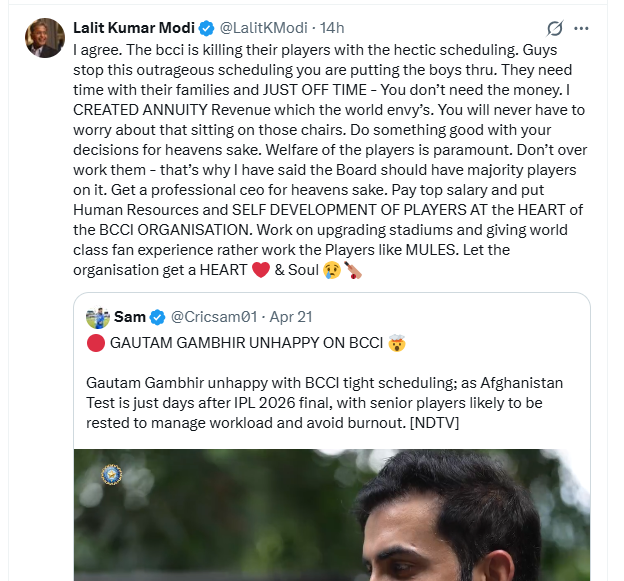
At the core of the tweet is a strong emotional appeal—players are not machines. They are individuals with families, mental health needs, and physical limits.
The argument that “you don’t need the money” is particularly striking. The BCCI is widely regarded as the richest cricket board in the world, generating massive revenue through broadcasting rights, sponsorships, and leagues like the IPL. This raises a fair question: if financial security is already achieved, why push players so hard?
One of the biggest issues with hectic scheduling is burnout. Continuous cricket leaves little time for recovery. Injuries have become more frequent, and players often have to choose between formats to manage workload. Many top cricketers have stepped back from Test cricket or limited-overs formats simply to survive the schedule. This not only affects their careers but also impacts the quality of the game.
Mental fatigue is another serious concern. Being in bio-bubbles during events like the ICC Cricket World Cup and other series has already shown how isolation can affect players. Constant travel, media pressure, and performance expectations create a stressful environment. Without proper rest and personal time, even the best athletes can struggle.
The tweet also suggests structural changes in how the BCCI operates. One major recommendation is having more former players in decision-making roles. This idea has merit. Players understand the physical and emotional demands of the game better than administrators. Their presence on the board could ensure that policies are more balanced and player-friendly.
Another key suggestion is hiring a professional CEO. While the BCCI is financially powerful, it often operates differently from modern corporate organizations. A professional CEO with expertise in sports management could bring better planning, transparency, and long-term vision. This includes smarter scheduling, player rotation policies, and improved communication between stakeholders.
The mention of “Human Resources and self-development” is also important. In many global sports organizations, player welfare departments focus on mental health, career planning, and life after retirement. Cricket is slowly moving in this direction, but there is still a long way to go. Programs that help players manage stress, develop new skills, and prepare for life beyond cricket can make a huge difference.
Interestingly, the tweet shifts focus from players to fans as well. Instead of overworking players, the board should invest in better stadiums and fan experiences. This is a powerful point. Many cricket venues in India still lack world-class facilities. Improving infrastructure, seating, safety, and digital experiences can enhance fan engagement without increasing the burden on players.
From a business perspective, this approach is also sustainable. A better fan experience leads to stronger brand loyalty, higher ticket sales, and long-term growth. It shows that success in sports is not just about the number of matches played but also about the quality of the experience offered.
However, it is also important to look at the other side.
The demand for cricket has never been higher. Broadcasters, sponsors, and fans all expect regular content. Cutting down matches could impact revenues and global competitiveness. Balancing commercial interests with player welfare is not easy.
This is where smart scheduling becomes crucial. Instead of reducing cricket drastically, the focus should be on better planning. Rotating players, creating clear windows for leagues, and ensuring mandatory rest periods can help maintain both performance and well-being. Other sports like football and basketball have already adopted such systems successfully.
The emotional tone of the tweet—calling for “heart and soul” in the organization—reflects a deeper frustration. It is not just about schedules or money; it is about values. Sports organizations are not just businesses; they are custodians of the game and the people who play it.
In conclusion, the criticism of the BCCI’s scheduling is not without reason. While the board has achieved incredible financial success, it now faces a new challenge: protecting its most valuable assets—the players. By prioritizing welfare, involving players in decisions, adopting professional management practices, and investing in fan experiences, the BCCI can set a global example.
Cricket’s future depends not just on how much it grows, but on how responsibly it grows.
| Section | Key Idea | Explanation (Simple English) |
|---|---|---|
| Introduction | Growing concern over scheduling | A tweet criticizing the Board of Control for Cricket in India highlights worries that players are being pushed too hard due to packed schedules. |
| Modern Cricket Reality | Year-round cricket | Cricket is no longer seasonal. With bilateral series, global tournaments, and leagues like the Indian Premier League, players hardly get breaks. |
| Core Argument | Players are not machines | The tweet emphasizes that players have families, mental health needs, and physical limits, and should not be overworked. |
| Financial Perspective | BCCI’s strong revenue | Since BCCI earns huge money from media rights and sponsorships, the question arises: why overwork players if money is already secure? |
| Physical Impact | Burnout and injuries | Continuous cricket leads to fatigue and injuries. Players often skip formats to manage workload, affecting their careers. |
| Mental Health | Stress and isolation | Events like the ICC Cricket World Cup and bio-bubbles have shown how isolation and pressure impact mental health. |
| Structural Suggestion 1 | More players in decision-making | Former players should be part of the board as they better understand the challenges faced by current players. |
| Structural Suggestion 2 | Professional CEO | Hiring a professional CEO can improve planning, transparency, and long-term strategy in cricket management. |
| Player Development | HR and self-growth | Focus should be on mental health support, career planning, and preparing players for life after cricket. |
| Fan Experience | Improve stadiums | Instead of adding more matches, BCCI should invest in better stadiums and fan engagement. |
| Business Insight | Sustainable growth | Better fan experience builds loyalty and long-term revenue without overburdening players. |
| Counter Argument | High demand for cricket | Fans, sponsors, and broadcasters expect constant matches, making it difficult to reduce scheduling. |
| Solution | Smart scheduling | Player rotation, fixed league windows, and mandatory rest can balance performance and health. |
| Emotional Angle | Need for values | The tweet reflects frustration and calls for more empathy, “heart and soul” in decision-making. |
| Conclusion | Future of cricket | BCCI must balance growth with responsibility and prioritize player welfare to set a |
.
Q 1: Why is the BCCI’s cricket schedule being criticized so much?
The scheduling by the Board of Control for Cricket in India is facing criticism because it has become extremely packed over the years. Players are now involved in continuous cricket through bilateral series, ICC tournaments, and franchise leagues like the Indian Premier League. This leaves very little time for rest and recovery.
Many experts and former players believe that such a hectic calendar increases the risk of injuries and burnout. Cricketers are expected to perform at the highest level across formats, travel frequently, and deal with constant media pressure. This not only affects their physical health but also their mental well-being.
Another major reason for criticism is that the BCCI is already financially strong. With huge revenues coming from broadcasting rights and sponsorships, there is less pressure to schedule excessive matches purely for financial gain. Critics argue that instead of focusing on quantity, the board should focus on quality—both in terms of matches and player welfare.
The debate is not about stopping cricket but about managing it better. Smarter scheduling, rotation policies, and mandatory rest periods are being suggested as practical solutions to balance entertainment with player health.
Q 2: What changes can improve player welfare in Indian cricket?
Improving player welfare requires both structural and cultural changes within the Board of Control for Cricket in India. One key suggestion is to include more former players in decision-making roles. Their real-life experience can help create policies that are more balanced and realistic.
Another important step is hiring a professional CEO with expertise in sports management. This can bring better planning, transparency, and long-term vision to scheduling and player management. Introducing proper Human Resources systems focused on mental health, stress management, and career development is equally important.
Workload management should also be a priority. This includes rotating players across formats, setting clear windows for tournaments like the ICC Cricket World Cup, and ensuring mandatory rest periods. These steps can help players stay fresh and perform consistently.
Additionally, shifting focus toward improving stadium infrastructure and fan experience can reduce the need for excessive matches. Better facilities, digital engagement, and world-class venues can drive revenue without overburdening players.
In simple terms, the future of Indian cricket depends on balancing commercial success with human care.
The post From Revenue to Responsibility: Why BCCI Must Prioritize Player Welfare Over Scheduling” appeared first on Sportzcraazy.
from Cricket News & Updates | Today Cricket Rankings | Latest Match Schedule https://ift.tt/rEya8gb
via IFTTT




0 Comments