
The Indian Cricket team had run full of ups and downs in T20 World Cup where they didn’t reach in the semifinal round by playing quality cricket .
It has been full of hiccups where they had a hard time in encounteritng victories.
Let me first share the records in the below format:
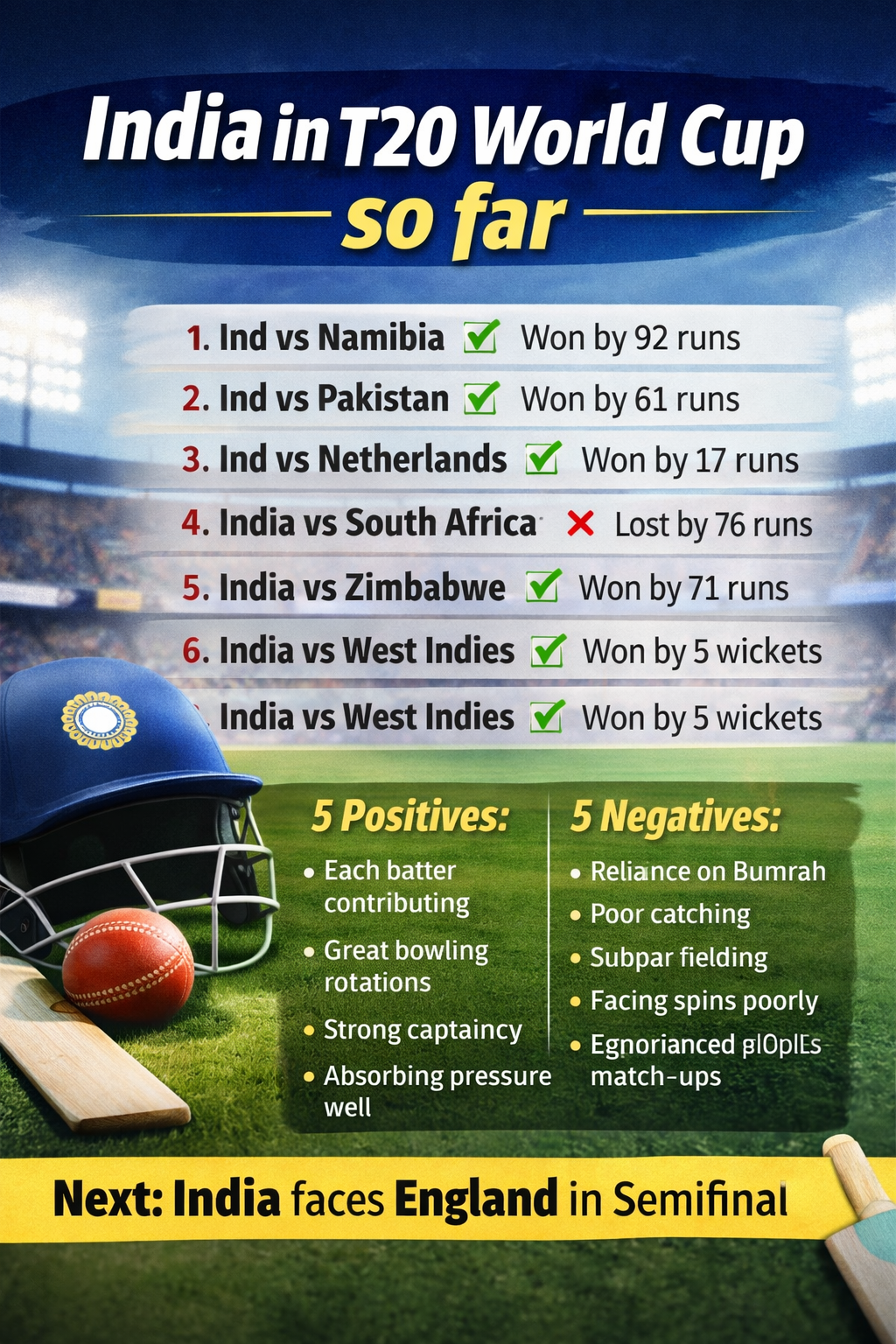
1, Ind vs Namibia: India won by 92 runs
2. Ind vs Pakistan: India won by 61 runs
3. Ind vs Netherlands: India won by 17 runs
4. India vs South Africa: India lost by 76 runs
5. India vs Zimbabwe: India win by 71 runs
6. India vs West Indies: India won by 5 wickets
In the upcoming encounter, He will be facing England in the semifinal in Mumbai.
When you look at the fielding and dropping catches ratio have been pretty low in comparison to all teams, is not good and they need to up their game going forward in order to seal semifinal birth and eventually making it to the final and winning it and successfully defending their title.
In hindsight,if you look India hasn’t played quality cricket still they have managed to reach in the semifinal if they can somehow manages to reach the final it would be different ball game all together.
The 5 Positives for Indian team so far have been – each and every batter contributing different facet of game, great bowling rotations, captaincy, ability to absorb pressure and experience players delivering when it mattered the most.
The 5 Negatives for Indian team so far have been- Too much reliance on Bumrah to deliver when it comes to taking wickets, Poor Catching, Poor Fielding standards, Facing spin problems in countering especially at the top and not relying on match ups some time which might also include exclusion of Kuldeep Yadav from squad.
Let’s see how India fares going forward.
More Details on Indian Cricket Going Forward:
The Indian cricket team’s campaign in the T20 World Cup has been nothing short of dramatic — a journey filled with commanding wins, sudden collapses, tactical questions, and moments of brilliance.
On paper, the results show dominance in most league games:
India vs Namibia – Won by 92 runs
India vs Pakistan – Won by 61 runs
India vs Netherlands – Won by 17 runs
India vs South Africa – Lost by 76 runs
India vs Zimbabwe – Won by 71 runs
India vs West Indies – Won by 5 wickets
Despite this impressive win column, the performances have not always reflected complete control. India has often looked slightly unsettled — winning games, but not always dictating them.
Now, with a high-stakes semifinal clash against England in Mumbai approaching, the real test begins.
The Paradox: Winning Without Peak Performance
In hindsight, India hasn’t consistently played flawless cricket in this tournament. There have been phases of batting stagnation, moments of bowling indiscipline, and noticeable lapses in fielding intensity. Yet, they have still managed to secure a semifinal berth.
That says two things:
The team has depth.
They have the ability to win even when not at their absolute best.
If India somehow clicks collectively in the semifinal or final, it could become a completely different ball game.
Major Concern: Fielding Standards
One of the biggest areas of concern has been fielding. Compared to other top teams in the tournament, India’s dropped-catch ratio has been on the higher side. In knockout cricket, one dropped catch can change the destiny of a match.
Against stronger oppositions like England, half-chances must be converted. The outfield has to be sharper. Direct-hit opportunities must be taken. Pressure in T20 cricket is often built through fielding excellence — something India must elevate immediately if they want to defend their title successfully.
The 5 Positives So Far
1. Collective Batting Contribution
Unlike past tournaments where one or two batters carried the innings, this time almost every batter has stepped up at different moments. That distributed responsibility reduces scoreboard pressure.
2. Bowling Rotations
The captain and team management have rotated bowlers intelligently depending on match situations. Using match-ups strategically in patches has helped in restricting oppositions during middle overs.
3. Captaincy
The leadership has shown calmness under pressure. Field placements, bowling changes, and game-reading have largely been proactive rather than reactive.
4. Ability to Absorb Pressure
In tight games, especially during chases, India hasn’t panicked. They have paced innings smartly and absorbed pressure phases before counter-attacking.
5. Experienced Players Delivering
Senior players have stepped up in crunch moments — whether stabilizing innings or breaking partnerships. Experience in ICC tournaments always counts, and it is showing again.
The 5 Negatives So Far
1. Over-Reliance on Jasprit Bumrah
Whenever breakthroughs are needed, the expectation automatically falls on Bumrah. While he has delivered consistently, knockout games require support bowlers to share that burden.
2. Poor Catching
Dropped catches have been costly. Against teams like England, such lapses can decide the match within a few overs.
3. Fielding Intensity
Beyond catching, ground fielding standards have not been elite. Extra singles, misfields, and slow reactions add pressure on bowlers.
4. Struggles Against Spin at the Top
There have been visible issues while countering quality spin in the powerplay or early middle overs. This vulnerability could be exposed by smart oppositions.
5. Match-Up Hesitation
At times, tactical rigidity has been noticeable. Questions around not fully trusting match-ups — including debates around options like Kuldeep Yadav — indicate areas where flexibility could improve.
The Semifinal Challenge vs England
England is a side that thrives on momentum. Their aggressive batting lineup can dismantle bowling attacks if early breakthroughs don’t come. India’s powerplay bowling and fielding sharpness will be crucial.
Mumbai conditions could favor batting under lights. Dew might play a role. Toss could become decisive. But beyond conditions, it will come down to execution under pressure.
The Bigger Picture
India has reached the semifinal without playing its absolute best cricket. That can either be a warning sign — or a dangerous signal for opponents.
If:
• The top order clicks together
• The middle order accelerates smartly
• The bowlers share wicket-taking responsibility
• Fielding standards improve
Then India becomes a complete unit.
Defending a T20 World Cup title requires mental toughness, adaptability, and flawless execution in knockouts. India has shown glimpses of all three — but not consistently in one single match.
The semifinal against England will reveal whether this campaign was about survival — or about dominance waiting to unfold.
Let’s see how India fares going forward.
India’s T20 World Cup Campaign – Performance Analysis
Match Results Summary
| No. | Match | Result | Margin |
|---|---|---|---|
| 1 | India vs Namibia | Won | 92 runs |
| 2 | India vs Pakistan | Won | 61 runs |
| 3 | India vs Netherlands | Won | 17 runs |
| 4 | India vs South Africa | Lost | 76 runs |
| 5 | India vs Zimbabwe | Won | 71 runs |
| 6 | India vs West Indies | Won | 5 wickets |
Overall Campaign Assessment
| Aspect | Observation |
|---|---|
| Tournament Journey | Full of ups and downs |
| Performance Quality | Not consistently dominant |
| Match Control | Won games but didn’t always dictate terms |
| Current Stage | Reached Semifinal |
| Upcoming Clash | Semifinal vs England (Mumbai) |
 The Paradox: Winning Without Peak Performance
| Key Insight | Explanation |
|---|---|
| Depth in Squad | Multiple players stepping up at different moments |
| Ability to Win Under Pressure | Managed victories even without flawless cricket |
| Concern | Inconsistency in overall dominance |
| Opportunity | If full team clicks, semifinal/final becomes a different contest |
Major Concern: Fielding Standards
| Issue | Impact |
|---|---|
| High Dropped-Catch Ratio | Gives opposition second chances |
| Poor Ground Fielding | Extra singles & pressure on bowlers |
| Knockout Risk | One mistake can decide semifinal outcome |
| Required Improvement | Sharper reflexes, direct hits, energy in outfield |
5 Positives So Far
| No. | Positive | Analysis |
|---|---|---|
| 1 | Collective Batting Contribution | Different batters contributing at different phases |
| 2 | Bowling Rotations | Smart usage of bowlers & partial match-up awareness |
| 3 | Captaincy | Calm leadership & proactive decision-making |
| 4 | Ability to Absorb Pressure | Composure during tight chases |
| 5 | Experienced Players Delivering | Senior players stepping up in crunch moments |
5 Negatives So Far
| No. | Concern | Analysis |
|---|---|---|
| 1 | Over-Reliance on Jasprit Bumrah | Wicket-taking burden falls heavily on him |
| 2 | Poor Catching | Costly errors in key moments |
| 3 | Fielding Intensity | Not elite compared to top teams |
| 4 | Struggles Against Spin | Top order discomfort in powerplay/middle overs |
| 5 | Match-Up Hesitation | Tactical rigidity, debates around Kuldeep Yadav exclusion |
Semifinal Challenge vs England
| Factor | Key Consideration |
|---|---|
| England’s Strength | Aggressive batting & momentum-based play |
| India’s Key Area | Powerplay breakthroughs & disciplined fielding |
| Venue | Mumbai – likely batting-friendly conditions |
| External Factors | Dew & toss could influence result |
| Deciding Element | Execution under pressure |
What Must Happen for India to Win
| Requirement | Why It Matters |
|---|---|
| Top Order Click Together | Strong foundation in powerplay |
| Middle Order Acceleration | Maintain scoring tempo |
| Shared Bowling Responsibility | Reduce over-reliance on Bumrah |
| Improved Fielding Standards | Avoid gifting runs & chances |
| Tactical Flexibility | Better match-up execution |
Bigger Picture
| Observation | Implication |
|---|---|
| India hasn’t played best cricket yet | Room for peak performance in knockouts |
| Still reached semifinal | Shows resilience & depth |
| Knockouts demand perfection | No margin for fielding errors |
| Title Defense Goal | Requires complete team performance |
Final Summary
| Reality | Opportunity |
|---|---|
| Campaign filled with hiccups | Semifinal offers reset moment |
| Performance not fully dominant | Potential to peak at right time |
| Tactical & fielding concerns | Correctable before final push |
The post T20 World Cup 2026: What’s Working and What’s Not for India So Far in Mega Event? appeared first on Sportzcraazy.
from Cricket News & Updates | Today Cricket Rankings | Latest Match Schedule https://ift.tt/NfIDsZG
via IFTTT



0 Comments