
Let’s Compare the Popularity of Pickleball in 2026: United States vs India:
Pickleball has rapidly evolved from a backyard recreational activity into one of the fastest-growing sports globally. However, its growth trajectory varies significantly across countries. In 2026, the contrast between the United States and India clearly highlights two different stages of the sport’s lifecycle—one being a mature market and the other an emerging powerhouse.
1. United States (2026):
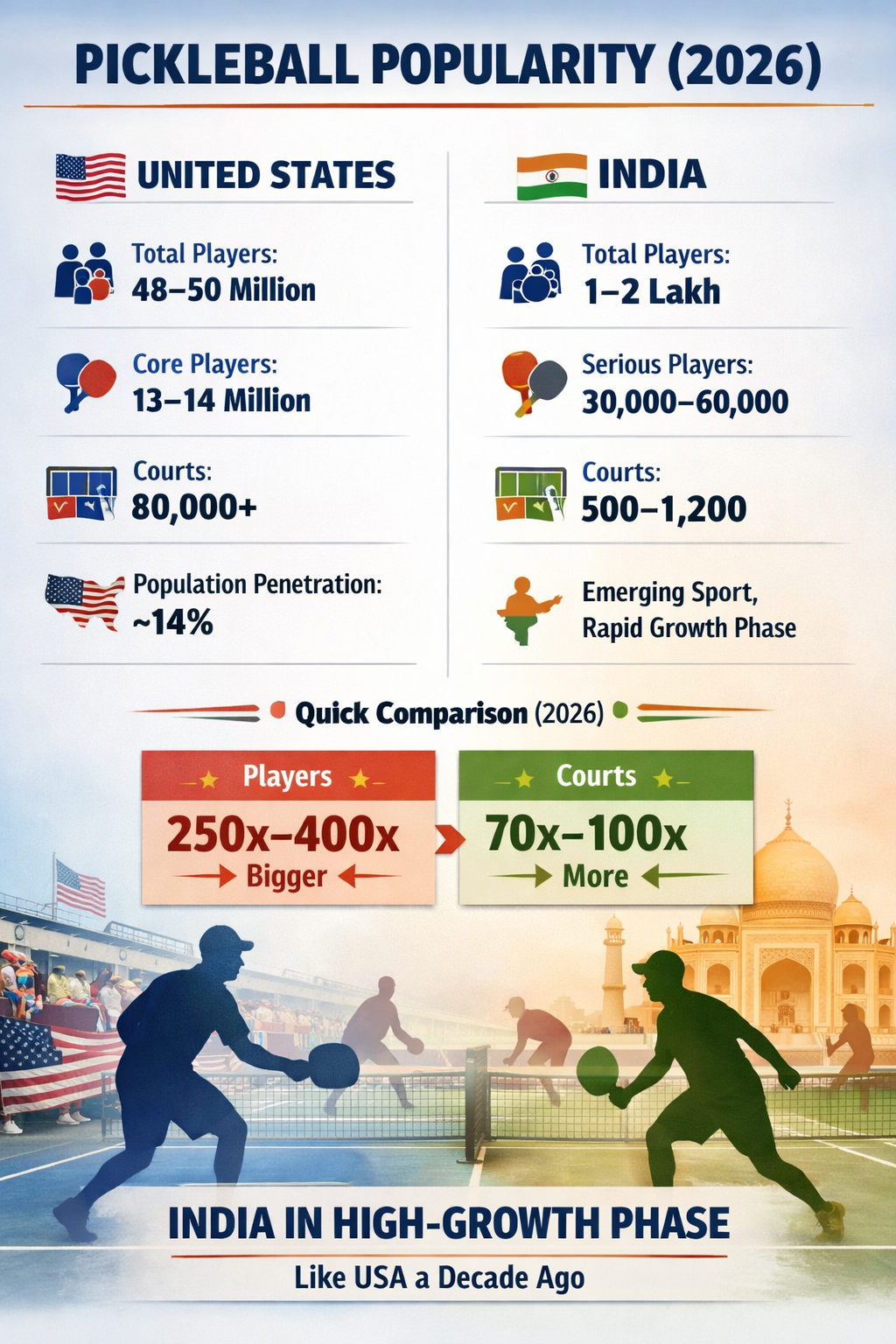
Total players: ~48–50 million
Core/regular players: ~13–14 million
Courts: 80,000+
Population penetration: ~14%
Pickleball in the United States is no longer just a trend—it is a full-fledged mainstream sport. With nearly 50 million people having played the game, it has surpassed many traditional sports in participation rates. What makes the US market particularly strong is not just the sheer number of players, but the depth of engagement.
Out of the total player base, around 13–14 million are considered core or regular players. This indicates a highly active community that plays frequently, participates in leagues, and contributes to the sport’s ecosystem. The presence of over 80,000 courts across the country further supports this growth, ensuring accessibility at schools, parks, clubs, and private facilities.
Another crucial factor is the sport’s wide demographic appeal. Unlike many sports that cater to specific age groups, Pickleball in the US is played by teenagers, working professionals, and even retirees. This inclusivity has played a massive role in driving its popularity. Additionally, the rise of professional leagues, celebrity investments, and media coverage has elevated Pickleball’s status from a casual pastime to a serious competitive sport.
In short, the United States represents a mature and saturated market, where the focus has now shifted from awareness to innovation, monetization, and professionalization.
2. India (2026):
Total players (active + casual): ~1–2 lakh
Serious/registered players: ~30,000–60,000
Courts: ~500–1,200
In contrast, India is at a much earlier stage in its Pickleball journey. With an estimated 1 to 2 lakh players, the sport is still relatively unknown to the masses. However, what stands out is the pace at which it is growing.
The number of serious or registered players, ranging between 30,000 and 60,000, indicates that a dedicated community is already forming. These are players who actively participate in tournaments, training programs, and club activities. While the infrastructure is still limited—with around 500 to 1,200 courts—the expansion is happening steadily, especially in metro cities like Mumbai, Delhi, Bangalore, and Hyderabad.
One of the key drivers of Pickleball’s growth in India is its accessibility. Compared to sports like tennis or golf, Pickleball requires less space, lower investment, and is easier to learn. This makes it highly attractive for urban populations looking for a social and fitness-oriented activity.
Moreover, startups, sports entrepreneurs, and private clubs are beginning to recognize the potential of this sport. Investments are slowly coming in, and organized tournaments are becoming more frequent. Social media has also played a significant role in spreading awareness, with creators and communities showcasing the sport’s fun and engaging nature.
India today represents a nascent but high-potential market, where awareness is increasing and the foundation for future growth is being laid.
Quick Comparison (2026)
Player base: The United States has a player base that is approximately 250x–400x larger than India.
Infrastructure: The US leads with 70x–100x more courts, making the sport far more accessible.
Market stage: USA = Mature market | India = Early growth stage
This comparison clearly shows the massive gap between the two countries. However, it also highlights the opportunity that lies ahead for India.
Sharp Insight:
While the difference in numbers may seem overwhelming, it is important to look at the bigger picture. India today is at a stage where the United States was nearly a decade ago. Back then, Pickleball in the US was also limited in reach, with fewer courts and lower participation.
What changed in the US was a combination of factors—community-driven growth, infrastructure development, media attention, and investment. India is now beginning to experience similar patterns. As awareness increases and more players get introduced to the sport, the growth curve could accelerate rapidly.
From an opportunity standpoint, this makes India an extremely exciting market. Whether it is setting up academies, building courts, organizing leagues, or creating content around the sport, the possibilities are vast. Early movers in this space have a significant advantage, as they can shape the ecosystem and establish themselves as key players in the industry.
Final Thoughts:
The comparison between the United States and India in 2026 is not just about numbers—it is about timing and potential. While the US showcases what a fully developed Pickleball ecosystem looks like, India offers a glimpse into the future of the sport.
The gap is large, but so is the opportunity. If the current momentum continues, India could witness exponential growth in the coming years, potentially becoming one of the key markets for Pickleball globally.
Key Metrics Comparison
| Parameter |  United States (2026) United States (2026) |
 India (2026) India (2026) |
|---|---|---|
| Total Players | ~48–50 million | ~1–2 lakh |
| Core/Regular Players | ~13–14 million | ~30,000–60,000 |
| Number of Courts | 80,000+ | ~500–1,200 |
| Population Penetration | ~14% | <0.1% |
| Market Stage | Mature & Saturated | Early Growth / Nascent |
| Accessibility | Highly accessible nationwide | Limited but expanding in metros |
| Ecosystem | Strong (leagues, media, investments) | Developing (startups, clubs emerging) |
Market Dynamics
| Aspect | United States |
India |
|---|---|---|
| Growth Stage | Mainstream adoption achieved | Rapid growth phase |
| Player Engagement | High (frequent play, leagues) | Growing community participation |
| Infrastructure | Well-established nationwide | Concentrated in metro cities |
| Demographics | All age groups (youth to seniors) | Mostly urban youth & working professionals |
| Investment Level | High (celebrity, private equity, leagues) | Emerging (startups, private clubs) |
| Awareness | Very high | Increasing but still low |
Direct Comparison (2026)
| Factor | Difference |
|---|---|
| Player Base | USA is ~250x–400x larger |
| Infrastructure | USA has ~70x–100x more courts |
| Maturity Level | USA = Mature Market |
| India = Early Growth Market |
Strategic Insight
| Insight Area | Analysis |
|---|---|
| Market Gap | Massive gap in both players and infrastructure |
| Growth Potential (India) | Very high due to low base and rising awareness |
| Historical Parallel | India today ≈ USA 8–10 years ago |
| Key Growth Drivers | Community building, infrastructure, media, investment |
| Opportunity Areas | Academies, leagues, content, court infrastructure |
Q-1. Why is Pickleball famous in USA?
Pickleball has gained massive popularity in the United States due to its simplicity, accessibility, and social nature. Community parks, schools, and clubs have widely adopted the sport, making it available to people of all age groups. Additionally, strong media coverage, celebrity investments, and the rise of professional leagues have significantly boosted its visibility. The sport also appeals to both competitive athletes and casual players, which has helped it grow across different demographics at an unprecedented pace.
Q 2. Why is Pickleball still at an early stage in India?
In India, Pickleball is still relatively new compared to established sports like cricket, badminton, and tennis. Limited awareness is one of the biggest challenges, as many people are still unfamiliar with the sport. Infrastructure is another constraint, with a smaller number of courts available mainly in metro cities. However, the situation is gradually improving as startups, sports communities, and private clubs are introducing the sport to a wider audience. Social media and grassroots initiatives are also playing a key role in spreading awareness and attracting new players.
Q 3. Can Pickleball become as popular in India as it is in the US?
Yes, Pickleball has the potential to grow significantly in India, although it may take time to reach the scale seen in the United States. The sport’s low entry barrier, minimal space requirements, and easy learning curve make it ideal for India’s urban population. As more courts are built and organized tournaments increase, participation is expected to rise. If supported by consistent investment, media exposure, and community engagement, Pickleball could become one of the fastest-growing recreational sports in India over the next decade.
Q 4. What are the biggest opportunities in the Indian Pickleball market?
The Indian Pickleball ecosystem offers multiple opportunities for early adopters. These include building dedicated courts, launching training academies, organizing leagues and tournaments, and creating digital content around the sport. Brands and sponsors can also explore partnerships as the sport gains visibility. Since the market is still in its early stages, there is a significant advantage for those who enter now and establish a strong presence. As the player base grows, these early investments are likely to yield long-term benefits.
Q- 5. What can India learn from the United States to grow Pickleball faster?
India can learn several important lessons from the United States to accelerate the growth of Pickleball. First, focusing on community-driven expansion can help build a strong player base at the grassroots level. Second, increasing the number of accessible courts is essential to encourage participation. Third, promoting the sport through media, influencers, and events can boost awareness. Lastly, attracting investments and creating structured leagues can help professionalize the sport. By adopting these strategies, India can shorten its growth cycle and scale the sport more efficiently.
The post Let’s Compare the Popularity of Pickleball in 2026: United States vs India appeared first on Sportzcraazy.
from Cricket News & Updates | Today Cricket Rankings | Latest Match Schedule https://ift.tt/7hV6ySd
via IFTTT


0 Comments