
The Indian Premier League 2026 season has introduced several new rules and refinements aimed at improving gameplay balance, fan engagement, and strategic depth. Governed by the Board of Control for Cricket in India, these updates reflect the league’s continuous evolution as one of the most competitive T20 tournaments in the world. Here’s a detailed 800-word breakdown of the key new rules for IPL 2026.
1. Impact Player Rule Refinement
The Impact Player rule, introduced earlier, has been slightly modified in IPL 2026. Teams can still substitute one player during the match, but now there are tighter restrictions on when and how the substitution can occur.
The Impact Player must be chosen from a pre-nominated list of five substitutes.
The substitution can only happen at the end of an over or during a natural break in play.
Teams must declare whether the incoming player is primarily a batter or bowler, limiting role-switching flexibility.
This tweak ensures the rule is not overly exploited and maintains balance between bat and ball.
2. Smart Review System (DRS Upgrade)
IPL 2026 introduces a more advanced Decision Review System (DRS), often referred to as the “Smart Review System.”
Players can now review wides and no-balls more effectively using enhanced tracking technology.
Ball-tracking accuracy has improved, reducing umpiring errors.
Teams still get two reviews per innings, but successful reviews do not count against the limit.
This upgrade improves fairness and reduces controversial decisions, enhancing the viewing experience.
3. Over-Rate Penalty Changes
To tackle slow over rates, IPL 2026 has stricter penalties:
Captains will no longer face immediate match bans for slow over rates.
Instead, teams will face on-field restrictions, such as fewer fielders outside the 30-yard circle in the final overs.
Financial penalties remain, but the focus is now more on in-game consequences.
This change ensures matches stay competitive without affecting team combinations due to bans.
4. Two Bouncers Per Over Rule Continues
The rule allowing two bouncers per over in T20 cricket continues in IPL 2026.
Bowlers can now use short-pitched deliveries more aggressively.
This adds a tactical layer, especially against power hitters.
The continuation of this rule keeps the contest between bat and ball more balanced.
5. Playing XI Announcement Flexibility
A significant strategic update allows teams to announce their playing XI after the toss:
Teams can name a larger squad before the toss.
Final XI selection happens depending on pitch and conditions.
This rule gives teams better tactical flexibility, especially in day-night matches where dew plays a role.
6. Introduction of Stop Clock Rule
To reduce delays between overs, IPL 2026 introduces a “Stop Clock” rule:
Fielding teams must start the next over within a fixed time (usually 60 seconds).
Failure to comply leads to warnings and eventual penalties.
This rule ensures faster gameplay and keeps matches within the scheduled time.
7. Pitch and Outfield Monitoring System
The BCCI has implemented stricter monitoring of pitch and outfield conditions:
Venues will be rated after every match.
Poor pitches (too slow, uneven bounce, etc.) may lead to sanctions or relocation of matches.
This ensures consistent playing conditions across venues.
8. Concussion Substitute Expansion
The concussion substitute rule has been expanded:
Teams can now replace a concussed player with a “like-for-like” player more flexibly.
Match referees have greater authority in approving substitutes.
Player safety remains a top priority with this rule enhancement.
9. Strategic Time-Out Adjustments
Strategic time-outs remain, but with minor adjustments:
Teams must use them within specific overs (not too late in the innings).
Broadcast integration has improved, making them more engaging for fans.
This keeps the commercial aspect intact while ensuring minimal disruption.
10. Enhanced Technology Integration
IPL 2026 focuses heavily on technology:
AI-driven analytics for teams and broadcasters.
Real-time player tracking for performance insights.
Improved stump mic clarity for better fan experience.
This technological push makes IPL more immersive for viewers.
11. Fair Play and Code of Conduct Updates
Stricter enforcement of fair play rules has been introduced:
On-field aggression and dissent towards umpires are penalized more heavily.
Players can face demerit points leading to suspensions.
This ensures discipline and maintains the spirit of the game.
12. Domestic Player Incentives
To promote Indian talent:
Teams are encouraged to include more uncapped Indian players.
Special incentives and recognition for emerging players.
This helps in strengthening the grassroots structure of Indian cricket.
Conclusion
The IPL 2026 rule changes highlight a clear intent by the BCCI to modernize the league while maintaining its competitive edge. From refining the Impact Player rule to introducing the Stop Clock and upgrading DRS technology, every change is designed to improve fairness, speed, and entertainment value.
These updates not only enhance the on-field contest but also ensure that fans get a smoother and more engaging viewing experience. As the IPL continues to grow globally, such innovations keep it ahead of other T20 leagues, reinforcing its position as the premier cricket tournament in the world.
If you want, I can convert this into a YouTube script, Twitter thread, or Instagram carousel for your Cricketwaali page.
| No. | Rule / Update | Description | Key Impact |
|---|---|---|---|
| 1 | Impact Player Rule Refinement | Impact Player must be selected from 5 substitutes. Substitution allowed only at the end of an over or natural breaks. Teams must declare player role (batter/bowler). | Prevents misuse and maintains balance between bat and ball. |
| 2 | Smart Review System (DRS Upgrade) | Enhanced DRS allows better review of wides and no-balls. Improved ball-tracking accuracy. Two reviews per innings; successful reviews retained. | Increases fairness and reduces umpiring errors. |
| 3 | Over-Rate Penalty Changes | No immediate captain bans. Teams face on-field restrictions like fewer boundary fielders in death overs. Financial penalties continue. | Keeps matches competitive while ensuring timely overs. |
| 4 | Two Bouncers Per Over | Bowlers allowed to bowl two bouncers per over. | Adds tactical depth and balances contest against aggressive batters. |
| 5 | Playing XI Flexibility | Teams can announce final XI after toss. Larger squad named before toss. | Improves strategic decisions based on pitch and conditions. |
| 6 | Stop Clock Rule | Next over must start within ~60 seconds. Delays lead to warnings and penalties. | Speeds up the game and reduces delays. |
| 7 | Pitch & Outfield Monitoring | Venues rated after each match. Poor conditions may lead to sanctions or match relocation. | Ensures consistent and high-quality playing surfaces. |
| 8 | Concussion Substitute Expansion | More flexibility in like-for-like replacements. Match referees have greater control. | Enhances player safety. |
| 9 | Strategic Time-Out Adjustments | Time-outs must be taken within specific overs. Better broadcast integration. | Maintains flow while supporting commercial needs. |
| 10 | Enhanced Technology Integration | AI analytics, real-time player tracking, improved stump mic clarity. | Improves fan engagement and viewing experience. |
| 11 | Fair Play & Code of Conduct | Stricter penalties for aggression and dissent. Demerit points may lead to suspensions. | Promotes discipline and sportsmanship. |
| 12 | Domestic Player Incentives | Encouragement to include uncapped Indian players. Recognition for emerging talent. | Strengthens grassroots and future talent pool. |
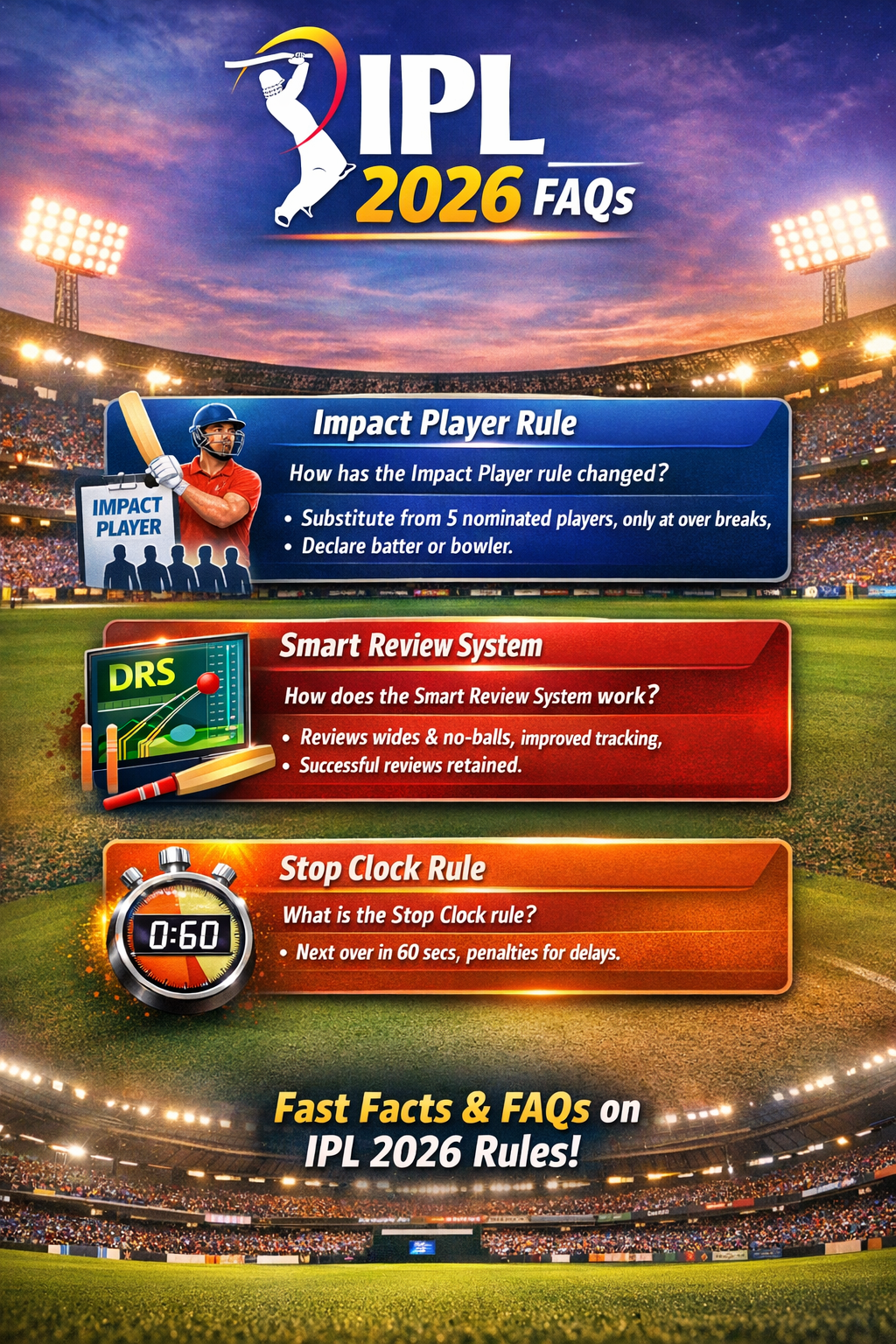
1. What is the Impact Player rule in IPL 2026 and how is it different now?
The Impact Player rule in the Indian Premier League 2026 season allows teams to substitute one player during a match, but with refined restrictions. Teams must choose the substitute from a list of five pre-nominated players. The substitution can only take place at the end of an over or during natural breaks, ensuring minimal disruption to gameplay. Additionally, teams are required to declare whether the incoming player is primarily a batter or a bowler, which limits excessive tactical manipulation. This updated version ensures fair usage of the rule while maintaining a balance between batting and bowling strengths.
2. How does the new Smart Review System improve decision-making?
The Smart Review System is an upgraded version of DRS introduced to enhance accuracy in umpiring decisions. Players can now review wides and no-balls more precisely using improved tracking technology. The ball-tracking system has been refined to reduce human error, making decisions more reliable. Teams are still allowed two reviews per innings, and importantly, successful reviews are not deducted from the total. Governed by the Board of Control for Cricket in India, this system ensures fairness and transparency, which ultimately improves both the competitive integrity of the match and the viewing experience for fans.
3. What is the purpose of the Stop Clock rule in IPL 2026?
The Stop Clock rule has been introduced to speed up the pace of matches and reduce unnecessary delays. According to this rule, the fielding team must begin the next over within a fixed time frame, typically around 60 seconds. If teams fail to comply, they receive warnings followed by penalties for repeated violations. This rule ensures that matches are completed on time and maintains a smooth flow of play. It also enhances the spectator experience by reducing downtime, making the game more engaging and fast-paced, which aligns with the evolving demands of modern T20 cricket.
The post IPL 2026: 10 Iconic Rules for Indian Premier League 2026 in Detail appeared first on Sportzcraazy.
from Cricket News & Updates | Today Cricket Rankings | Latest Match Schedule https://ift.tt/w8S72c1
via IFTTT



0 Comments