
Why India vs Pakistan at T20 World Cup 2026 Has Become an Absolute Circus?
The India–Pakistan cricket rivalry has always lived at the intersection of sport, politics, and public emotion. But what is unfolding ahead of the T20 World Cup 2026 feels less like high-stakes diplomacy and more like a poorly scripted circus—confusing, contradictory, and exhausting for fans.
On one hand, Pakistan’s cricket establishment has publicly signalled reluctance, even resistance, to playing India under certain conditions. On the other hand, behind closed doors, discussions continue. Meetings happen. Schedules remain flexible. Broadcasters prepare. The same match that is “not happening” politically somehow continues to exist commercially.
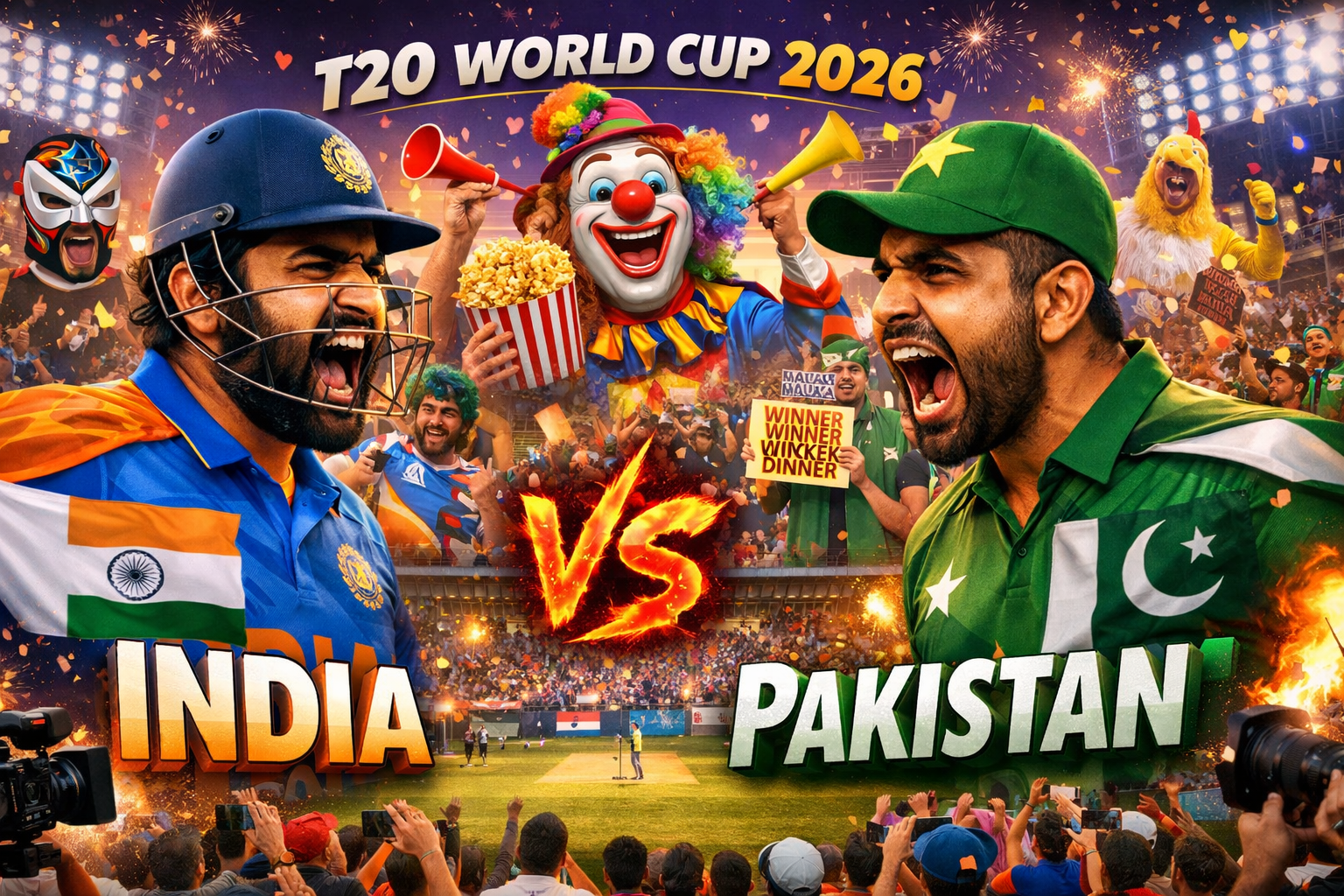
This contradiction is exactly why the situation has spiralled into chaos.
Public Posturing vs Private Negotiations
The biggest reason this has turned into a farce is the gap between public statements and private actions.
Officially, there are strong positions taken—press conferences, statements to media, hints of boycotts, references to national interest. But unofficially, cricket boards, ICC officials, and commercial partners keep the door open. That dual-track communication creates confusion, fuels speculation, and erodes credibility.
If a team truly does not want to play another, the decision should be firm and final. Instead, what we see is strategic ambiguity—say no loudly, negotiate quietly. For fans, this looks dishonest. For the global cricket ecosystem, it looks unserious.
ICC’s Silence Is Loud
The International Cricket Council (ICC) has played a major role in letting this drama drag on. Rather than offering clarity, the ICC has chosen silence—or worse, carefully worded non-statements.
The reason is obvious: India vs Pakistan is cricket’s biggest commercial asset.
One India–Pakistan match can fund multiple associate tournaments. Broadcasters price their deals around it. Sponsors activate entire campaigns around it. Ticket sales skyrocket. Digital engagement multiplies. The ICC knows that removing this fixture creates a financial vacuum.
So instead of taking a clear stand, the ICC allows uncertainty to linger, hoping diplomacy—or exhaustion—will resolve things. In doing so, it sacrifices transparency for revenue.
Pakistan’s Mixed Messaging
Pakistan’s position has been especially confusing. Publicly, there is defiance. Privately, there is engagement.
This inconsistency weakens Pakistan’s negotiating power. If the stance is political, it must be consistent. If it is logistical, it must be communicated honestly. But oscillating between refusal and negotiation only invites criticism and makes the board look reactive rather than strategic.
It also puts players in an impossible position—caught between national sentiment and professional responsibility—without clear guidance.
India’s Quiet Control of the Narrative
India, on the other hand, rarely speaks loudly—and that is precisely its advantage.
By letting others talk, react, and contradict themselves, India maintains leverage without escalating rhetoric. The Board of Control for Cricket in India (BCCI) understands its central role in world cricket economics. It doesn’t need to threaten; its influence is structural.
That silence, however, contributes to the circus because it leaves room for speculation. When one side talks too much and the other talks too little, the vacuum fills with rumours.
Fans Are the Real Losers
Lost in all this are the fans—the very people whose passion sustains the sport.
Indian fans don’t know whether to anticipate the match or emotionally detach. Pakistani fans feel whiplash between hope and defiance. Neutral fans grow cynical, seeing the rivalry reduced to bargaining chips rather than competition.
Cricket thrives on narratives, but this narrative feels manipulative. When fans feel toyed with, trust erodes—not just in boards or officials, but in the sport itself.
The Players Deserve Better
Cricketers prepare for World Cups years in advance. Training cycles, tactical planning, mental preparation—all depend on knowing who you’ll face and when.
Uncertainty around such a marquee fixture disrupts preparation and adds unnecessary pressure. Players are asked about politics instead of performance. They become spokespersons when they should be athletes.
A sport that claims to be player-first cannot keep putting its stars in this position.
Commercial Interests vs Sporting Integrity
At the heart of this circus is a fundamental tension: commerce versus integrity.
Everyone involved knows that an India–Pakistan match is too valuable to lose. And yet, pretending otherwise—while continuing negotiations—undermines the idea that cricket operates on principles.
If money ultimately decides outcomes, the system should at least be honest about it. The current charade insults intelligence.
What Needs to Happen
This saga doesn’t need more statements. It needs decisive action.
Either:
Declare clearly that India and Pakistan will not play each other at the T20 World Cup 2026, and redesign the tournament accordingly.
Or:
Admit that sporting and commercial realities outweigh political posturing, and confirm the fixture transparently.
Anything in between only prolongs the farce.
Conclusion: A Rivalry Deserves Respect, Not Confusion
India vs Pakistan is too important a rivalry to be reduced to leaks, denials, and backroom talks. It deserves clarity, honesty, and respect—for the players, the fans, and the game itself.
Right now, what should be cricket’s greatest spectacle looks like an administrative mess. Until boards and the ICC stop pretending and start leading, the circus will continue—and cricket will pay the price.
Why India vs Pakistan at T20 World Cup 2026 Feels Like a Circus
| Aspect | What’s Happening | Why It’s a Problem |
| Public vs Private Stance | Publicly, strong political statements and hints of refusal. Privately, meetings continue, schedules stay flexible, broadcasters prepare. | Creates confusion and erodes credibility. Fans feel misled when “not happening” matches keep existing commercially. |
| Contradictory Messaging | Loud public posturing paired with quiet negotiations behind closed doors. | Strategic ambiguity makes boards look dishonest and unserious, damaging trust in cricket governance. |
| ICC’s Role | ICC avoids clear statements, issues vague responses, and lets uncertainty linger. | Silence prioritizes revenue over transparency, turning governance into a waiting game. |
| Commercial Reality | India–Pakistan match is cricket’s biggest financial asset—funding ICC events, broadcasters, sponsors, and digital engagement. | Financial dependence prevents decisive action, trapping the ICC in indecision. |
| Pakistan’s Position | Public defiance contrasts with private engagement in discussions. | Weakens negotiating power and makes the PCB appear reactive rather than strategic. |
| Impact on Pakistani Players | Players are caught between national sentiment and professional duty. | Creates mental pressure and lack of clarity for athletes preparing for a World Cup. |
| India’s Strategy | India maintains near silence, letting others react and contradict themselves. | Structural power gives India leverage, but silence fuels speculation and rumours. |
| Narrative Control | One side talks too much, the other too little. | Information vacuum gets filled with leaks, half-truths, and media chaos. |
| Fans’ Experience | Indian fans don’t know whether to anticipate or detach; Pakistani fans face emotional whiplash. | Fans feel manipulated, leading to cynicism and declining trust in the sport. |
| Neutral Viewership | Rivalry appears less about cricket, more about bargaining and politics. | Reduces the sporting value of one of cricket’s greatest fixtures. |
| Players’ Preparation | Uncertainty affects training cycles, tactics, and mental readiness. | Players become political spokespersons instead of focusing on performance. |
| Sporting Integrity | Everyone knows money will decide, but no one admits it openly. | Hypocrisy undermines the principles cricket claims to stand for. |
| Core Conflict | Commercial interests clash with political posturing and sporting ethics. | The system looks dishonest rather than pragmatic. |
| What Needs to Happen | Either clearly cancel the fixture or transparently confirm it. | Anything in between prolongs confusion and damages cricket’s credibility. |
| Overall Verdict | A historic rivalry reduced to leaks, denials, and backroom talks. | What should be cricket’s biggest spectacle now feels like an administrative mess. |
The post Why India vs Pakistan at T20 World Cup 2026 Has Become an Absolute Circus? appeared first on Sportzcraazy.
from Cricket News & Updates | Today Cricket Rankings | Latest Match Schedule https://ift.tt/XWdD9Cu
via IFTTT


0 Comments